The Navy Retirement Timeline
Every fixed deadline in your last twenty-four months of service, on one page, with the law or the instruction behind each one.
Take the timeline with you.
Everything on this page is free and stays free. Get it as a single printed sheet you can put on the wall or in the front of the file.
The Final Watch takes your retirement date and your terminal leave date and runs this entire framework against them, with every deadline already attached and in order. It is open now, and the first seven days are free.
FREE. TAKE IT WITH YOU.
- The whole timeline on one page, built to print and pin up
- Blank lines at the top for your two dates
- Yours to keep, free, no account needed
The printout downloads on the next screen. Nothing else unless you ask.
The Final Watch is a retirement preparation framework for United States Navy officers and senior enlisted in their final twenty-four months of service. It organizes the retirement process into four phases, Setting the Watch, Standing the Watch, Relieving the Watch, and Securing the Watch, and anchors every task to two dates: your retirement date and your terminal leave date. It was built by Brian Reynolds, MSC, USN (Ret), a retired Mustang with twenty years of service, six enlisted and fourteen commissioned, who backward planned his own retirement by hand on a paper calendar because no single tool did it for him. Everyone else organizes forward from today. The Final Watch organizes backward from your retirement date.
Everything that is fixed, on one line
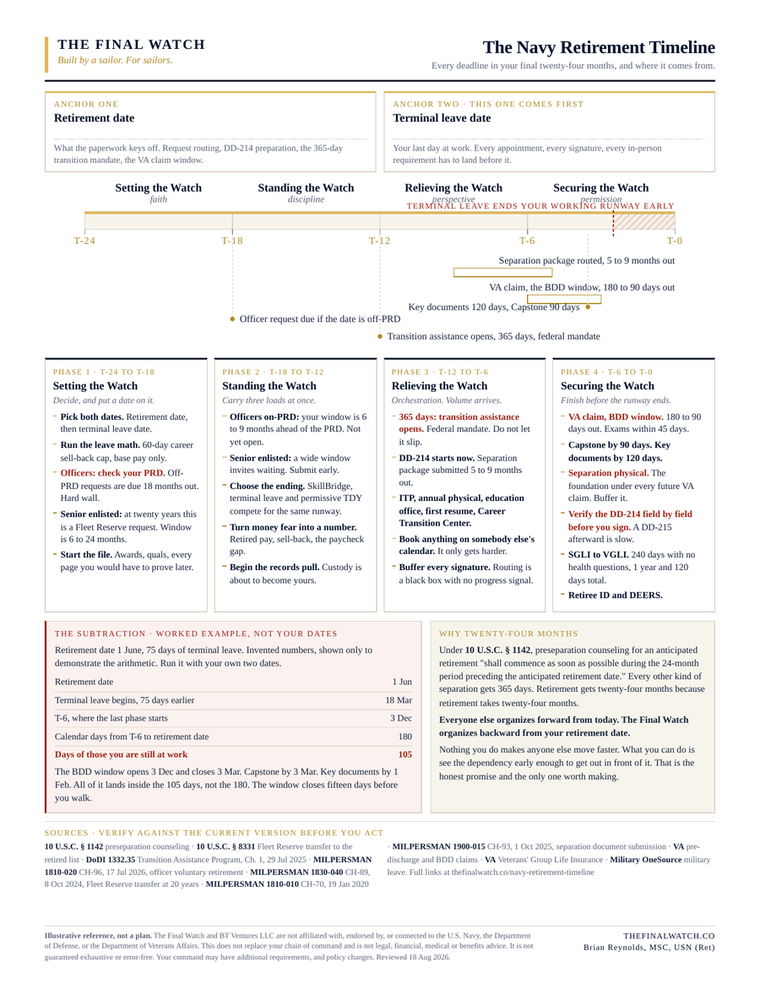
Illustrative. The gold deadlines are fixed by law and instruction and apply to everyone. The red block is terminal leave, shown at 75 days as an example. Your own dates move that line.
The framework
Four phases, six months each, running from twenty-four months out to the day you step off. Each phase has a different kind of work in it, so each one has a different voice.
Two bookends sit outside the watch. Pre-Watch covers groundwork you can start any time before T-24, the early TAP sitting, the transition fund, the credentialing look. Post-Watch covers day zero through your first year out, where deadlines keep running after the uniform comes off. You cannot stand a watch before you are on it or after you are relieved, so neither is a phase of the watch. Both still have dates.
Terminal leave eats the runway. If you are six months out and taking 75 days of terminal leave, you do not have six months. You have about three and a half.
Almost everything in the last phase is due before your terminal leave date, not before your retirement date. The VA claim window, the Capstone, the final appointments. There is a worked example further down.
Phase 1 · T-24 to T-18Setting the Watch
You decide, and you put a date on it.
- Pick both dates. Your retirement date is what the paperwork keys off. Your terminal leave date is what your life keys off, and it comes first.
- Run the leave math. Sixty-day career sell-back cap, base pay only. Terminal leave pays your full package.
- Officers, check your PRD. If your retirement date is off-PRD, the request must be received 18 months out. That is a wall, not a guideline. MILPERSMAN 1810-020
- Senior enlisted, know the door. At twenty years this is a Fleet Reserve request, 6 to 24 months prior. MILPERSMAN 1830-040
What nobody tells youThe decision is the easy part. Defending it for eighteen months, to people who matter to you, is not.
Trust your gut. Trust your training. And all will fall into place.T-24
Phase 2 · T-18 to T-12Standing the Watch
You carry three loads at once, and nobody gives you time for the first one.
- Officers on-PRD: not yet. Your window is 6 to 9 months ahead of the PRD. Early does not help. Late is not recoverable.
- Senior enlisted: the wide window is the trap. Six to twenty-four months invites waiting. Submit early and spend the saved months on records.
- Choose how your career ends. SkillBridge, terminal leave and permissive TDY draw on the same finite runway. This is a T-18 decision. By T-6 it has been made for you.
- Start the records pull while you still have system access and time to fix what is missing.
What nobody tells youSubmitting feels like finishing. It is initiation. A new set of gates opens, and you have no leverage inside any of them.
Do your homework, embrace the process, and move forward.T-18
Phase 3 · T-12 to T-6Relieving the Watch
The volume arrives all at once. The problem becomes orchestration.
- 365 days: transition assistance opens. A congressional mandate, not a suggestion. You cannot skip it. DoDI 1332.35
- Your DD-214 starts here, not at the end. The separation package is submitted 5 to 9 months out, from data other people enter. MILPERSMAN 1900-015
- The heaviest quarter is T-12 to T-9. Individual Transition Plan, annual physical, first resume off your FITREPs or evals, Career Transition Center. Clear the decks before it lands.
- Book anything that needs somebody else's calendar. It only gets harder from here.
What nobody tells youOnce your package routes it disappears. No progress signal, only approved or disapproved at the end. Build buffer into every step that waits on another person's signature.
Buckle up, this year will pass quickly, and you'll be on terminal leave before you know it.T-12
Phase 4 · T-6 to T-0Securing the Watch
Finish before the runway ends. The runway is shorter than the calendar says.
Worked example. These are not your dates. The numbers below are invented to show the arithmetic. Your retirement date, your terminal leave length, and your command's requirements will produce different answers. Run it with your own two dates before you plan against anything here.
Retirement date 1 June. Seventy-five days of terminal leave. Nothing unusual about either number.
| Retirement date | 1 Jun |
| Terminal leave begins, 75 days earlier | 18 Mar |
| T-6, where this phase starts | 3 Dec |
| Calendar days from T-6 to your retirement date | 180 |
| Days of those you are still at work | 105 |
Now lay the fixed deadlines on top. The VA BDD window opens 3 December and closes 3 March. Capstone is due by 3 March. Key supporting documents are due by 1 February. Every one of them lands inside the 105 days, not the 180.
The BDD window closes fifteen days before you walk. The separation physical, the records pull, and every signature you need in person have to fit in the same stretch. Take 120 days of terminal leave instead and you walk on 1 February. The window stays open another month, but you are not there to use it.
- VA claim, the BDD window. File 180 to 90 days out, and be available for exams within 45 days. Under 90 days you are filing a standard claim instead. VA
- Capstone by 90 days. Key documents by 120 days.
- The separation physical. It documents your body at separation and is the foundation under every VA claim you will ever file. It is fragile to reschedule. Buffer it, and pull every page of your record before you lose access.
- Verify the DD-214 field by field before you sign. A DD-215 afterward runs through a records centre you no longer have access to.
- SGLI to VGLI: 240 days with no health questions, 1 year and 120 days total.
What nobody tells youNothing you do makes anyone else move faster. Seeing the dependency early enough to get out in front of it is the only lever you have. That is the honest promise and the only one worth making.
The end is near. Make sure you take time for yourself during these closing months.T-6
The two dates, one more time
If you take one thing from this page, take this.
| Anchor | What it is | What it drives |
|---|---|---|
| Retirement date | The date on the paperwork | Retirement or Fleet Reserve request routing, DD-214 preparation, the 365-day transition mandate, the VA BDD window |
| Terminal leave date | Your last day at work | Every appointment, every signature, every in-person requirement |
Your retirement date is what the system keys off. Your terminal leave date is what your life keys off, and it comes first. Plan against the wrong one and you lose the only thing in this process you cannot get back.
What The Final Watch does with this
What it does
- Sequences the four authorities against your two real dates
- Flags every item that is permanent or time-barred
- Shows you which items gate other items, early
TAP, MILPERSMAN and the VA all publish what to do. None of them publishes when, in what order, or what breaks if you are late. That gap is the only thing this fills.
What it will not do
- Make Navy Personnel Command route your package any faster
- Make the VA schedule your physical sooner
- Replace your chain of command, or give legal, financial, medical or benefits advice
What it can do is make the dependencies visible early enough that you stay out in front, without giving up another year of evenings to build the plan yourself. That is the only promise here.
Put your own two dates in.
Everything above works on paper. Take the one-page version, write your retirement date and your terminal leave date at the top, and run the subtraction yourself. That is the whole method.
thefinalwatch.co
The questions people ask first.
- What is The Final Watch?
- Retirement planning software for U.S. Navy officers and senior enlisted. It reconciles the four authorities that govern a Navy retirement into one sequenced 24-month framework, anchored to your retirement date and your terminal leave date.
- Who is it for?
- Navy officers and senior enlisted inside roughly 24 months of a retirement date. It is built around the Navy's own instructions and routing, so it is aimed at career retirees rather than short separations.
- How is this different from the free checklists?
- TAP, MILPERSMAN and the VA all publish what to do. None of them publishes when, in what order, or what breaks if you are late. The Final Watch sequences those sources against your two real dates and flags every item that is permanent or time-barred.
- When should I start?
- Twenty-four months out. That is not our number. Under 10 U.S.C. § 1142, preseparation counseling for an anticipated retirement "shall commence as soon as possible during the 24-month period preceding the anticipated retirement date." Every other kind of separation gets 365 days.
- Is this affiliated with the Navy, DoD or the VA?
- No. The Final Watch is not affiliated with, endorsed by, or sponsored by the U.S. Navy, the Department of Defense, the Department of Veterans Affairs, or any U.S. Government agency. It is a planning tool. It does not replace your chain of command and it does not provide legal, financial, medical or benefits advice.
- What does it cost?
- The Final Watch is open now. The On Watch monthly plan is $12.99 and starts with a 7-day free trial. The prepaid plans — $109 for 12 months, $169 for 18, $219 for 24 — are paid once at checkout with no trial, and carry a 30-day, no-questions-asked refund. This one-page timeline stays free either way.
That is the timeline. All of it, free.
Take the printed version with you, or start a 7-day free trial and put your own two dates in.
Sources
- 10 U.S.C. § 1142, Preseparation counseling. The 24-month retirement window and the 365-day floor.
- 10 U.S.C. § 8331, Fleet Reserve transfer to the retired list. Transfer at 30 years of service.
- DoD Instruction 1332.35, Transition Assistance Program, Change 1, 29 July 2025. The 365-day start and Capstone not later than 90 days.
- MILPERSMAN 1810-020, Submission of Application for Voluntary Retirement from Active Duty (Officer), CH-96, 17 July 2026.
- MILPERSMAN 1830-040, Transfer to Fleet Reserve and Release from Active Duty, 20 Years, CH-89, 8 October 2024. States its submission windows by paygrade.
- MILPERSMAN 1810-010, Voluntary Retirement of Enlisted Personnel, 30 or More Years of Active Service, CH-70, 19 January 2020.
- MILPERSMAN 1900-015, Separation, Fleet Reserve, and Retirement Document Submission, CH-93, 1 October 2025.
- VA, Pre-discharge claims and the BDD program.
- VA, Veterans' Group Life Insurance.
- Military OneSource, Military leave and how it works.
Brian Reynolds, MSC, USN (Ret). Twenty years, six enlisted and fourteen commissioned. Hospital Corpsman to Medical Service Corps officer.
Every citation on this page points to the public source so you can read it yourself. Last reviewed 18 August 2026. Policy changes — verify against the current instruction before you act on any date on this page.